
The Question Concerning Technology in the Middle East
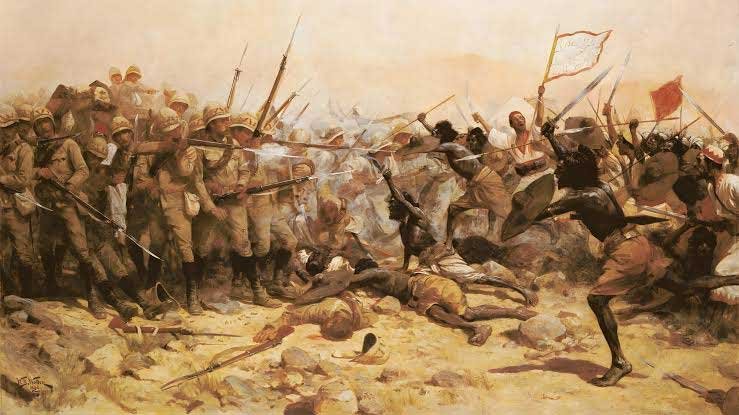
Colonial forces masscare the Mahdi rebellion.
Let us put forward three cases involving the sociality of technology in the greater Middle East. These three historical moments will allow us a gateway to the complex question concerning the use and adoption of technological advancement in the Middle East and the global south. The first scene takes us back to September 1898, at Kerreri, eleven kilometres north of Omdurman in Sudan. An army of 8,000 British colonisers and a mixed force of 17,000 Sudanese and Egyptians is led by Herbert Kitchener. The colonial army’s objective was to wipe out the 60,000 strong Sudanese tribesmen led by Abdulla al-Taashi the successor of Mahdi, Muhammad Ahmad (Fulton 2020). At 6.00 AM the battle began with thousands of native men under the command of Osman Azrak (Raugh 2004, 257). The Mahdists rode and marched directly at the waiting British colonial army. What awaited these men was something they have never seen, heard or perhaps even imagined before—the horrifying thunder and rattling of the world’s first machine gun, the Maxim. In the words of historian of empire, Martin Gilbert, the Maxim was ‘the weapon most associated with imperial conquest’, it fired six hundred rounds per minute (Stevenson 2004, 7). The gun ‘used the energy of each bullet’s recoil force to eject the spent cartridge and quickly insert a new bullet’ (Roby 2015, 70-71). Twenty ‘relentless’ Maxim machine guns, accompanied by bold action rifles and field artillery, began firing at Azrak’s men when they reached 2,000 yards (Bolger 1991, 28-29). The Maxim gun fired without stop for forty-five minutes. By 6:45 am ‘Kitchener’s troops had fired about 200,000 rounds of small arms ammunition and at least a 1000 artillery rounds, the dervish onslaught was halted and the Mahdist units virtually annihilated’(Raugh 2004, 257).
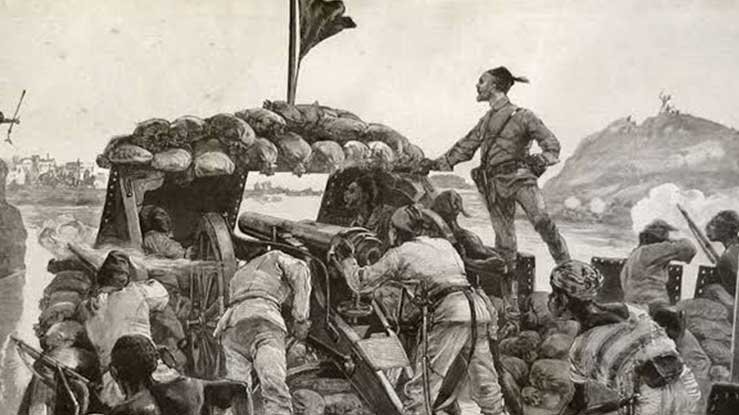
The Maxim Machine gun is used for the first time in quashing colonial battles.
Our second scene takes us to the eve of a revolution that begins in Sidi Bouzid, Tunis. It is eighteenth of December 2010. An everyday ubiquitous event, a slap and the confiscation of a rented scale, a few crates of pears and apples worth $225, leads to the public self-immolation of a street vendor named Muhammad Bouazizi(Globalist 2011). This set in motion a revolution had spread from Tunis to Libya, Algeria, Egypt, Yemen, Lebanon, Jordan, Syria, Iraq, and Bahrain. At the forefront of this mobilisation was the systematic utilisation of novel instruments of production, and cultural and information technologies. The revolution was partly fuelled by online publishing platforms, Web 2.0 and participatory culture and network intelligence, semantic technologies and fast and widespread accessibility of information, workflow integration and mobile technologies that flattened informational domains (Han 2009). Digital revolutions in communication led to revolutionary dispersion of the mass demands (Noueihed and Warren 2012). Every moment of the uprising was disseminated by and through digital technologies: captured by mobiles, shared by Facebook, Twitter and YouTube accounts (Burns, Highfield, and Burgess 2013). Millions of tweets containing the hashtags #HumanRights, #ArabSprings, #Tunisia or #Sidibouzid, #Jan25, etc. broadcasted instantly each moment of the uprising and struggle for the whole world to see (Rorke, Mendez, and Ceja 2019). In no time, apropos utilisation of these digital technologies, the collective mobilisation of the peoples of the region had ended the rule of Zine al-Abidine, Hosni Mubarak Ali Abdullah Saleh and Muammar Gaddafi. But the fall of the Arab spring came just as soon as it had emerged. The so-called ‘Arab Winter’ came with renewed and more powerful authoritarianism at the hands of states imposing new repressive regulations, laws and policies. Aiding and complementing this repressive state apparatus were digital authoritarian strategies which sought to repress, surveil and manipulate the population back into interpellation and subjugation (Jones 2022), at an unprecedented speed and scale. The new policies included internet blackouts, the control of telecommunications networks to block unwelcome communications, internet firewalls, targeting VPN users and encrypted VOIP apps, blocking of specific content, removal of websites, spreading of misinformation about activists, using bribe digital platforms ‘€5,000 and €10,000 to remove the accounts of critical journalists and activists’, etc (Lynch 2022).
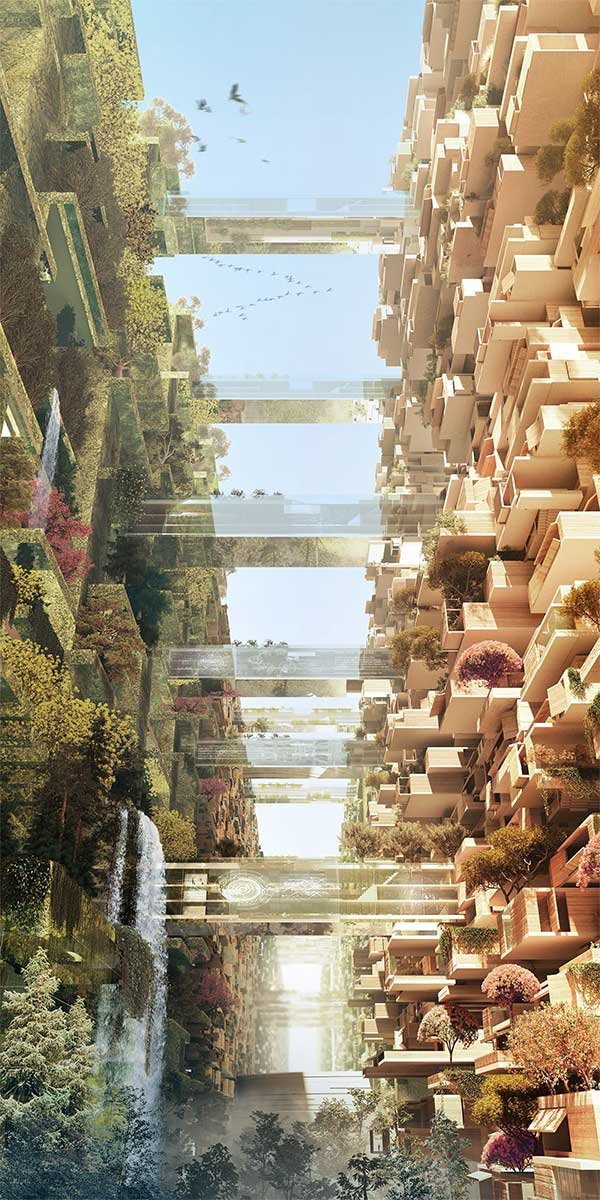
Saudi’s Neom Project, The Line
The third scene takes us to the mountainous deserts of Tabuk in Saudi Arabia. It is October 2022, and drone footage from the Saudi government shows a fleet of bulldozers, trucks and diggers accompanied by hundreds of mostly foreign workers excavating the foundations of The Line. Earlier, Mohammed bin Salman, the Crown Prince and Chairman of NEOM Board of Directors had announced the inauguration of a $725 billion high-tech futuristic mega project. The Line was set to not only ‘redefine the concept of urban development and what cities of the future should look like’, but it was also going to be a ‘civilizational revolution that puts humans first’(Neom 2023)—of course, the category of ‘human’ is reduced here to the 450,000 humans from local and global middle class who have the economic and cultural capital to purchase property in the vertical smart city. What the government reports veiled was the fact that the Saudi state had also just begun a campaign of cleansing and massacring of the traditional occupants of the region. Its military and police forces had begun violently evicting the native Huwaitat tribe. News outlets around the world reported that the state had given the green light to execute or imprison those who opposed eviction from their traditional land (Orr 2023). Against these everyday lived realities of locals, the official discourse emphasised the highly productive, post-scarcity technical and exciting future that comes with the Fourth Industrial Revolution (4IR). The Line was to be the ruling class’s attempt in accelerating large-scale responsive and efficient development projects whose ‘governance, principles, policies and protocols’(Revolution 2023) were to be integrated and aligned with the 4IR. Air quality monitoring, transport, traffic management, supply forecasting, security and surveillance, asset protection, smart waste management and unparalleled social opulence and luxury is to be organised by ‘future-ready computing and a truly intelligent universal platform that’s intuitive, predictive and immersive’. This will all be built on ‘cutting-edge partner network to develop solutions and devices’(Neom 2023) that are designed to enhance and accelerate interconnectivity and scientific progress. The Line is a synthesis of feudal traditionalism meeting hyper-capitalism through petrodollars. It is a world where a comprador class locks out its supernumerary populations in order, to borrow from Adam Smith, to allow the property owners ‘the secure and peaceable possession of his own property’(Smith 1978, 5). This site is a gated community on AI and technological steroids. A techno-dystopia celebrating the triumph of capitalist productive forces and consumption organised by cognitive technologies, Internet of Things (IoT), Artificial Intelligence (AI), robotics and biotechnology. And outside of The Line, and the proliferation of its technological wonders, lies a world of Mbembean necropolitics, where the masses, stuck in late-feudalism but with cellular mobiles, Snapchat and satellite tv, have unlimited access to death, wretchedness, exploitation, or at best alienation and Ronaldo’s football matches on YouTube.
We have then three instances: the Maxim gun mowing the colonized, digital platforms as a site of rebellion and repression, and cognitive systems being the infrastructure of a futuristic city that excludes the many. At first glance they seem to have little in common and are from unparallel worlds, diverse social formations and cultures, distinct epochs, even demographies. But a more systemic analysis unravels invariant material patterns, a certain colonialist-capitalist historicity, and an ontology of technology circulating within and between them. Three technical artefacts and infrastructure in the global south that dictate not only social interactions but also the existence, being and life-chances of the multiples in their respective social world. And in each synchronic moment, it appears the ideographic interaction between the antagonistic social forces (exploited-have-not vs. exploiter-haves) is influenced, even organised by the form of ownership, the use and access to the technological product, device, or systems. In fact, from the three social scenes, we can logically deduce a nomothetic ontological axiom: ‘technologies mediate power’. Nomologically and diachronically the proposition connotes that from the steam engine and telegraph to radio, electricity and computer to the AI, technologies have led to the production, distribution, exercise and re-production of unequal power configurations and patterns. In other words, technological advancement is a story of two antagonistic narratives: transnational prosperity and local misery, elite opportunity and mass domination, liberty and utility for the property-owner and restriction and social exploitation for the commoner. And it seems this social configuration is only made possible through a symbiosis between technological and politico-economic inequality.
Now that our logical exposition has put forward this hypothesis the task is then to prove it. The paper is organised through three sections. In the second unit an ontological conceptualisation of technology is put forward. A historical materialist and dialectical definition is contrasted to technological neutralism and autonomism. Taking the results of the second unit, the third section inductively takes the argument that technology requires a historical method that ought to examine the development of the technological and sociological phenomena in totality. The socio-technological story of the Middle East is laid out by placing the region in the wider intersection of relations of global production, international division of labour, scientific innovations, and politico-military domination by the core-industrial states. This sociological-historical cartography lays out the sequence of the first three industrial revolutions in the Middle East. It demonstrates that power and monopoly of wealth, colonial violence and imperialism directed innovation and creation, but it also forced application of certain technologies that maximised the extraction of raw materials, exploitation of free or cheap labor through what Samir Amin called ‘unequal exchange’ and ‘super-exploitation’. Technological innovation is homological with surplus-value expropriation and maximization. In the last section, we look at the bijective inequality in access to technology and innovation, and access to capital and power by assessing the fourth industrial revolution. The prediction of the paper, derived from the historical materialist equation, is provocative but not written in stone. If in the previous three industrial revolutions the heterogenous peoples of the Middle East faced repression and exploitation, extraction of their natural resources and labor-power, and lack of political subjectivity and sovereignty, then the 4IR brings with it the possibility of social redundancy or extinction, and as planetary health indicators show, even ecological annihilation. The technological and economic monopoly supplemented by imperial military control of the planet is creating a systemic capacity that reduces the masses of the tricontinent and indigenous peoples elsewhere to a ‘use-less class’(Harari 2017), a supernumerary excess of a population that is existentially unnecessary and unwanted by global relations of production. It is either extinction, or the other alternative: the democratic communalization of the ownership of technological artefacts and infrastructure, the seizure of the state and the means of production and the abolishing of private property.