
|||
Middle East in the Grip of Colonisation and Three Industrial Revolutions
A historical materialist theory of technology needs a fusion of a structuralist and a horizontal account of history from below. In this way, colonialism can be read as a politico-economic relation between peoples, societies and competing state-capitalist powers. Colonialism is a story of how a ruling class after centralising and monopolising power and dominating the masses at home begins to venture outward. In Marx’s words the ‘need of a constantly expanding market for its products chases the bourgeoisie over the whole surface of the globe. It must nestle everywhere, settle everywhere, establish connections everywhere’ (Marx and Engels 2008, 38). Politico-economic and social incorporation of other peoples, states and societies into the capitalist system occurs through sheer force and domination at first. Via colonial military violence we get the material structuring of routes, interactions, processes, institutions, ideologies and the class formation. European states structuring and structured-by capitalist enterprises become economically, politically and militarily more powerful. Their production is further advanced, diversified yet specialized in high technical goods. Technical advancement in civil, industrial and military infrastructure fed a certain Eurocentric exceptionalism. The production of an advanced West came via the incorporation of ideological frameworks like stage theory, developmentalism, fetishization of progress and general racial schemas that condemned the other for their inferior minds, cultures, savagery and primitiveness. Andre Gunder Frank and Dependency theorists called these conditions and connections which subjected other peoples and societies as the intentional ‘development of underdevelopment’ in the peripheral regions(Frank 1989). The peripheral states and societies are subjugated and weak politically. They tend to be agricultural or feudal economies that do not have a powerful productive capacity(Frank 1989). They also specialise in the exportation of raw Agro-mineral products. The periphery similarly provides cheap lives and low-wage labour to the international system for profit and ‘super-exploitation’. It is underdeveloped because the metropolitan societies are advanced(I. Wallerstein 1974). Hence global capitalism is a stratified, relational, combined yet uneven system where the property-owning class of the core states dictate the international division of labour and system of profit.
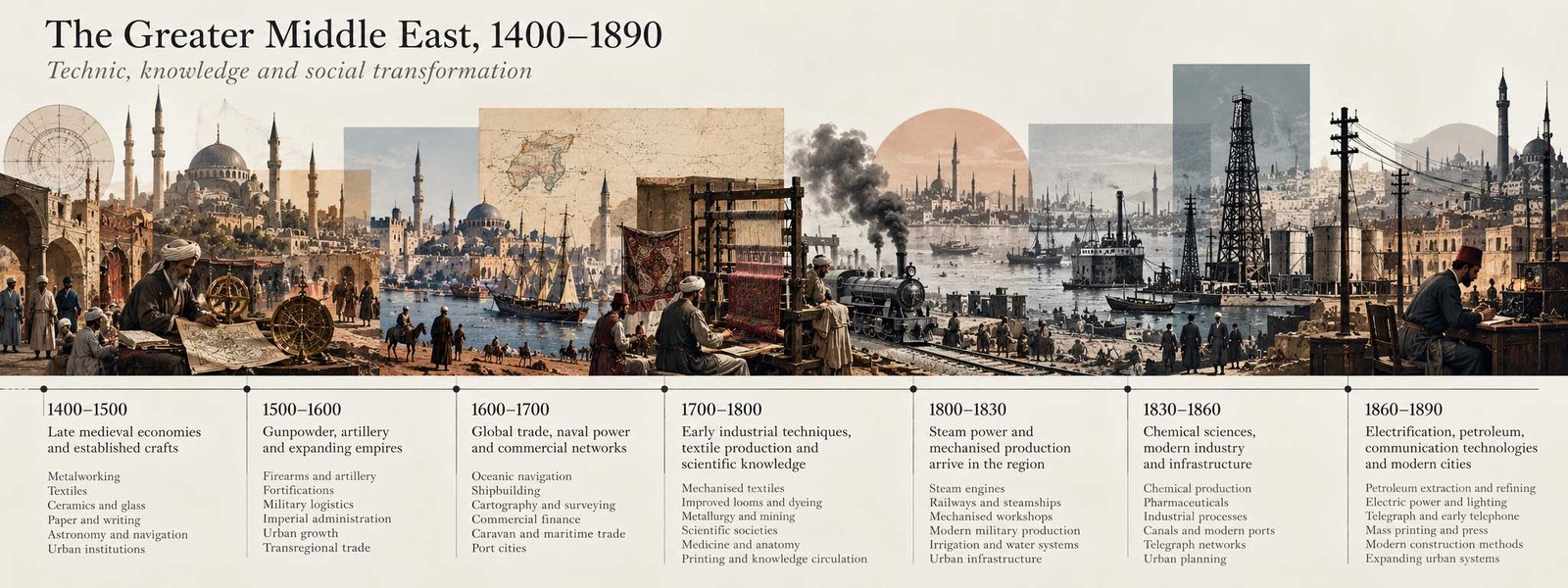
Five centuries of technological transformation in the Middle East, 1400–1890.
Yet it is not just a region’s developmental position (its lack of development, wealth, income by country and status in the international hierarchy, losses in exchange via unequal circulation of capital, etc.) that indicates the trajectory of a region. There is also a homologous technological and scientific story to be told within this framework. Because ‘science and technology enhance the capabilities of states and societies to obtain and transform resources’(Stivachtis 2019, 146), to intensify and expand productive capacities, to empower labour and scientific ventures, and just as importantly to ensure interconnection, security, and order. This technological story is a macro-historical process that begins at the outset of modernity and functions and develops gracefully in conjunction with the above international division of humanity.
And the story of underdevelopment of productive forces in the Middle East begins with what Brenner calls, the ‘crisis in feudalism’ in Europe(Brenner 1978). The intensification of conflict between the rural and urban classes in England and France led to radical intensification of contradictions between the relations of production and productive forces. ‘Primitive accumulation’ and intensification of conflict between peasants, feudal lords, aristocrats (Brenner 1978), and the newly emerging merchant bourgeois class led to the introduction of new techniques of labour, machinery, and technologies which in turn led to further modernisation of production process. The industrialisation and specialization of production and the increase in productivity led to a larger need for land, cheap labour and natural resources (cotton, rubber, wood, cotton, copper, gold, iron, oil, etc) (Parvanova 2017, 97). Furthermore, to maintain security and order in the emerging system of production that subjugated hundreds of thousands of European workers in textile, farming, pharmaceutical and machinery industries, and machine-building factories then a global reconstruction of the economy was required. The new to-be-colonies, the Middle East in particular, were also sites of ‘ready-made-market’ for mass produced European commodities. Egypt and Indian textile industries were smashed, and new consumers, customers and providers were found in the process. In the words of Henry Stanley to the Manchester Chamber of Commerce in 1884, ‘There are 40,000 of naked people beyond that gateway [of Europe], and the cotton spinners of Manchester are waiting to clothe them’(Parvanova 2017, 96). In this process technologies like spinning jenny, steamboats, locomotives and railroad, telegraph, guns, dynamite, the photography, and typewriter came with transferring of value from periphery to a militarised colonial core through unequal exchange, a system of globalizing production sustained by super-exploitation of colonized workers. Accordingly, technological advancement and adaptation in the region was the product of this new international division of production and labor.
The local impact of this process on the peoples and societies of the region was catastrophic. In the immediate rise of the First Industrial Revolution, the order and self-contained nature of the local production and political structures were torn apart. Ottomans, Qajars and Muhammad Ali’s Egypt had built a successful ‘centralized ruling apparatus and market penetration over large territories’(Harris 2019, 189). Wretchedness and destitution were periodical and tied to cases of extreme economic and ecological dislocation or disequilibrium. In 18th century on account of the Middle East being ‘economically advanced’, workers, skilled or unskilled, had their wages above the poverty line and their living standards on par, even ahead of workers elsewhere. Timur Kuran lists a ‘uniform legal system that supported intraregional commerce, partnership rules that supported commerce’ across sectors, waqf system, home-grown financial and technical innovations, as reasons for the region’s relatively advanced position (Kuran, 2023).
Capitalist expansion came with ‘territorial conquest, land annexation, enslavement, coerced labour, child abduction, and systematic rape’ (Fraser 2022, 35). But colonisation also came with intentional disruption and destabilising of old economic and social networks. Ultimately everything had to be restructured to ensure the flow of surplus to the core. All trade and exchange, confiscation and movement of goods and social relations of production led to or worked for the European capital and states. And the exchanges were heavily against the colonized. Productive forces and instruments of productions, storage, transportation and communication (like railroad, telegram and steam engine) were adopted in the region to tighten the newly emerging international organisation of the market. Or to simply move about military equipment or armies. In fact, this globalised system was only possible via ‘new steam-powered trains and ships’ which moved commodities, workers, and soldiers ‘faster and cheaper’ than ever before (Parvanova 2017, 97). In the process, the local composition of production and capital distribution was transmuted against the necessities of native life. Take the role of steam power and British influence in Iraq as an example. Early on the British while controlling India saw Iraq as only a route for the movement of resources, labor and capital. The first introduction of ‘modern’ technology came in the form of British naval power introducing armed steamers to the Mesopotamian rivers in 1835 and onward. The steamers’ weaponry (guns, mortars, etc.) ensured that the Tigris from Bagdad and Basra was free of Arab control(Parry 2013, 156). Previously British and Ottoman boats full of priced commodities and good were regularly attacked by nomads and local tribesmen. The boats and guns, and the equipping, funding, and supporting of local ruling circuit and their men was part of the plan by the British to ‘discipline and civilize unruly Arabs’(Parry 2013, 157).
With ‘trade and production diverted to European markets, and the lost control over merchant capital engaged’ in the global process the native ruling class became merely a node in the system. Heterogenous local production accompanied with local political power gave way to monocropped agriculture of wheat and cotton and colonial occupation(Harris 2016, 8-10). A global production process began to appear, but its necessities were tied to a) the adaptation of technologies that allowed for this unequal international trade, b)the use of machinery in production (specifically industrialising sectors) was tailored towards shifting the process of accumulation to the terrain of relative surplus-value, c) the process allowed and necessitated the reorganisation of reproduction of production and social life. To have crumbs of the imperial super-profit was to be incorporated as a node in the general division of labour and cycle of capital. But this was only possible for locals who sat in a certain position in the echelon of power. Those who had the political power, economic, social and scientific capital to adopt or use the emerging technologies could play the role of imperial proxy. This process led to the annihilation or immiseration of small handcraft artisans and merchants active in internal regional trade in the Middle East. In turn, a newly emerging ‘import-export merchants (the kernel of the comprador bourgeoisie) and commercial landowners (latifundists)’ (Riley 1989)—who had the green light from colonial forces—came to dominate new market relations. A process was beginning that anchored large part of the population in the Middle East to feudal production (or remnants of it) and its religious, traditional cultural and ideological framework. In turn, a small part of the population began to be incorporated into the lower echelon of the newly emerging managers of global production. This node in international division of labor was to be associated with science, modernity, technological incorporation and knowledges. Technology became a gateway to modernity, civilization, progress and prosperity but also, soon to be independent, state power.
Steam power, machine production, chemical sciences and technology, electrification, petroleum production and refining, communication technologies, radio, electric power and engineering, and countless advances in medical science, construction technologies, city planning, and management systems all had dramatic [and unequal] consequences for the Arab world(Stivachtis 2019, 153).
With time the restructuring of local economy and social system was done through establishing the local comprador class or what Hanna Batatu named ‘new men of capital’. This class was made of European settler-managers and professionals, shaykhs and large landed proprietors, or ‘retainees of ruling pashas’, military and intelligence officers, bureaucrats, and intellectuals (Harris 2016, 14). The soon to be national semi-feudal semi-bourgeois class became a key protagonist—through the command of the state and acquisition and accumulation of wealth—they became the authors of the technological story in the region. Their psycho-sociological interests were oriented around a few key conceptual interests: maintenance of order and security, control, and surveillance. In fact, we can say from the beginning productive forces and technological advancement in the region was authoritarian. Mostly this is due to the positionality of this comprador class in the global division of power and labor. The comprador class was violently subjugated and dictated by the European bourgeoisie while fettered by feudalism and challenged consistently on the ground by revolutionaries, social radicals and rebels. In order to maintain their power, the comprador class selectively allowed only certain technologies to reach the region. They asked only for those technologies that allowed their factions to remain either relevant to or competitive against the European ruling classes. Or they acquired technologies that allowed them enough power to extract surplus-value and dominate and control their peasants and working population. As such,
The imported technological advancements from the European colonisers fragmented, broke down, weakened local interconnections and bonds. It increased inequality in the local, national, and international level. Local advancement in research, design, innovation, and production was marginalised. Instead, all technologies were imported unquestionably and at times with enthusiasm from those who benefited from it. In no time a whole host of ‘consultants, contractors, operators, financiers’ from the comprador class began to occupy themselves with importing of devices, artefacts and systems from Europe (Stivachtis 2019, 153). The emergence of the new uneven mode of production led to the establishment of imperial-controlled cosmopolitan centres and better equipped powerful military forces. To protect commodities, property and sites where Middle Eastern cheap resources were packed and labour was exploited in mass then then security, military and political force was needed. The imperialists decreed that commodities, machines, confiscated land and profits in the metropoles had to be protected. The local and global ruling classes not only agreed on this but came to justify their existence, their heavy hand their fetish for advanced military technologies (Stivachtis 2019, 152-155). ‘Protection of profit is only possible if we rule by iron hand over the workers’, they decreed. The comprador class made importation and adaptation of these European weaponry a key policy. In fact, it is not controversial to generalise and state that this fetishization of Western weaponry beginning with the Ottomans, Qajar and Muhammad Ali has continued to this day (case point being Al Saud family and their recent $110 billion-dollar contracts with the Americans).
Kevan Harris in Making and Unmaking of the Greater Middle East (2016) states that the comprador classes, fearful of the Europeans and pushed locally by rebels (from Mahdi to the Shirazi Bab all the way to Sheikh Said of Kurdistan), had to constantly direct their ‘remaining resources towards military upgrading’(Harris 2016, 9). In fact, if factories were established by ruling elites, they were ‘mainly designed to meet military needs’(Issawi 1980, 472). Meanwhile the centres also required the introduction of new means of communication and dissemination of ideas (printing press, telegraph, books, newspapers, photography and later on telephone, etc.). The adaptation these technologies was also equally military and security-driven. These mediums allowed for establishment of stratified oppressive state bureaucracies, and the dissemination of uniform and monochromatic imperial or anti-colonial ideas. But there is little doubt, just as Napoleon’s army incorporated savants who introduced the region to European engineering, cartography, architecture, astronomy, botanism, etc., (Said 1979, 80-83) these new technologies came with new means of surveillance, control, and domination by the colonial forces. In the case of telegraph, telegraphic messages, lines, and stations were all tools of power that first strengthened the hold of colonial government and then later arbitrary states like Iran, Egypt and Turkey over their disparate populations. The telegraph was a tool, a technological artefact that allowed for ‘communication at a distance’ a means of compressing time and space, of overcoming rigid environment of facilitating market and political decision makings. More importantly it allowed for a more rigorous and expansive supervision of activities, and more systematic documentation and storage of information. In fact, as Paul Fletcher writes:
Steam power, machine production, chemical sciences and technology, electrification, petroleum production and refining, communication technologies, radio, electric power and engineering, and countless advances in medical science, construction technologies, city planning, and management systems all had dramatic [and unequal] consequences for the Arab world(Stivachtis 2019, 153).
Apropos their private or statist form of ownership, and like the telegraph, the newspaper, telephone, fax and digital means of communication all ‘played a police function’(Karuka 2019, 40). Post-World War I, these instruments of production of culture became tools of nationalism, myth-making and political independence. But the ownership and use of these mediums remained largely in the hands of a small population from the comprador and the slowly emerging middle class.
The aforementioned police function was also a constant motive for large transport and infrastructural building projects. Urban planning, architectural policies, and space organisation, along with modern railroads and trains ‘carried the devastation of industrial warfare’. Railroads and other means of transportation had the potential to radically transform ‘possibilities for capital accumulation’(Karuka 2019, 40). And while cotton, wheat, leather, and oil required such internal land based regional grids, the imperialists were hesitant in supporting such enterprise for it might create tight social networks and bonds between the locals. As such they ‘promoted only the technology that furthered their own interests and blocked such inventions as the railway, which might have benefited the […local] people, in case it endangered their own strategic positions’. In the case of Iran this also meant literally sabotaging and ceasing a process of production of native railway production process that had begun as early as 1886 by the Nasser-al-din Shah. Iraq was no different.
The post-independence states brought about the comprador class and new ruling elites into the helm of power. For Issawi scientific enterprises and technological advances continue to be structured and dictated by economic interests and political necessities of elites. With little legitimacy at home and abroad, the post-independent elites ‘were corrupt, inefficient, and often obstructive. They were dominated by bureaucrats, soldiers, and, occasionally landlords for whom fiscal preoccupations came far ahead of considerations of [economic and technological developments]’ (Issawi 1980, 473). They were not only ‘massively ignorant of economics’ but they also ‘had no room for protection and fostering of industry’(Issawi 1980, 473). Everything from motors, factory machinery, industrial supplies, assembly line equipment, and refrigerators had to be imported. The maintenance services, consulting, contracting services and the skilled workers too were brought in from outside. Nevertheless, the developmental state did not develop a program to build non-local technology and scientific know-how. Small sectors of the population belong to the comprador class or in alliance to it continued to benefit from the international system. And the previously developed core-periphery relation, feudal and capitalist divide widened further under the new states. So did the technological gap between the working-peasant masses and the middle and upper classes.
The core of these post-independent states, usually built around the capitals and the dominant ethnic and religious groups, were semi-industrialised, advanced and specialized metropoles that housed technical, skilled, and professional managerial workers and class. These major cities also attracted international capital and provided security to European settlers, intelligence, security and military officials of the empire, and the global capital managers. The rest of the country remained not only technologically barren and illiterate but for the most part feudal and tied to the same fragmented traditional agricultural farming that the colonialists first shattered.
Because they wished to accelerate the process of development, the new national elites unknowingly adopted methods that ultimately led to even greater technological dependence. As a result, foreign consulting firms conceived and designed enormous projects, foreign accounting and law firms monitored them, and an army of foreign contractors and foreign labour implemented them. Although major things were built, such as power and desalination plants, hospitals, irrigation schemes, enormous dams, transport systems, and airports, locals contributed little to the process. However, those who mediated these contracts earned enormous commissions and well- placed people accumulated personal fortunes in the billions of dollars (Stivachtis 2019, 154).
The economic and class divide that was organised and structured by international capital now had grown to exponential heights. This divide was also further stretching the technological, scientific, and educational divide. The techno-social inequalities led to fragmentation in social vision and belief system within the region. The region’s comprador class and the ‘stratum of officials’’ career, interests even existence remained tied to enforcing this economic and technological divide (Wallerstein 1974, 402). As such, the global organisation of production, foreign investment and imperial impositions by hegemonic states like the US ensured that this elite class in the region to play a pivotal supervisory role for a newly forming transnational capitalist class(Burns, Highfield, and Burgess 2013, 133; Edward L. Kick 2000). The underdevelopment of technology and scientific know-how in the Middle East was intentionally stretched and intensified to fit into the growing necessities of the core states and societies.
In the second part of twentieth century, this technological gap between the Middle East and the core states had stretched to new heights. The large revenue derived from fossil-fuel (oil and gas) exports allowed the rulers of these states tremendous power not only over society but also the technological, cultural and political direction of the states. The region’s authoritarianism, non-existent civil societies, rentier ideology and mentality, its patterns of patronage networks and labour bondage meant the incorporation of electronic networks, telecommunication grids were fundamentally tied to the ‘vicious entwining’ of the aforementioned hierarchical and reactionary traditional pre-capitalist social framework with the contemporary oil-based capitalist forms of oppression (Maxine Molyneux 1984). The energy sector and the alignment of its operations with the demands of global capital was fundamental not only in the technology race but also for the economy and societies of the region. The uneven development of the energy sector established first by the colonial states and later post-war transnational institutions at the behest of US and Europe was established so as to amplify the economic and technological inequalities. The core-states ensured that the global governance of finance, energy and later climate was set up in a way as to enable the extraction of fossil fuels in the Middle East for global markets, but limit utilisation of the same resources for local development needs. Iraq’s oil, gas and electricity crisis is a good case point here—despite the country being fourth in top oil producing countries in the planet, it suffers frequent shortages. Symons and Friedrich point out that since the hegemonic core states see control and autonomy over energy technologies (including continued access to oil, gas and coal) as ‘central to their economic development and military security’ they negotiated a system of global energy governance whose key function is to ‘supply the energy requirement of powerful states’ and while imposing the costs of achieving climate outcomes on the peoples and states of the periphery(Symons 2022).
The Iran-Iraq war, successive gulf wars, international sanctions, civil wars, corruption, lack of centralisation, further divided the region into the ‘have and have-nots’ of the technological and economical divide. The era was dominated by the rise of telecommunication and electronic apparatuses but subjected to enforcement from above by market and state powers. The GCC regions and certain metropolitan pockets in Egypt, Turkey and Iran began to witness the rise of programmable logics controllers (PLCS), PCS and with-it digital apparatuses, internet, e-ecommerce, email, Microsoft window. A few decades late, the Third Industrial Revolution had reached the comprador class and small pockets of the region. This was mainly at the behest and interest of the fundamental changes in a more digitalising, financialising, and free-floating transnational capital that began to globalize and unite the world into a single digital-driven and run market. This era saw the closure of factories and industries, accumulation by dispossession as the comprador class began to privatise and deregulate often through sheer violence; mass urbanisation as peasants were further kicked off from their lands; eradication of full-time employment in small pockets of industry; and the decline of services and opportunity for students, pensioners, disabled, the unemployed and working families(Harvey 2007). Large semi-feudal rural areas in the region continued to have the lowest per capital consumption, next to no education level (particularly amongst women), the lowest number of technical and skilled workers, doctors, and teachers in the region. These regions with no roads, electricity, hospitals, schools, and universities had remained partly semi-feudal.
The decline of state-developmental projects and the urbanisation of the masses came with neoliberal capitalist logic and culture. One area where the access to technology did not parallel the economic inequality was the consumptive and utility technologies, as opposed to productive technologies. Until the early 2000s many Middle Easterners were ‘scarcely aware of the internet’ while business, government and cultural elites organised politics and the market operations so as to ‘make their living from it’(PBS 2002). After 2000s, consumptive-technologies like satellite television, the rise of the personal computer, the development and spread of internet and emails along with high-speed fiber-optic cables and cellular phones became universally available in the region. This consumption technologies came with what liberal imperialists like Thomas Friedman called ‘globalization 3.0’. The globalisation enthusiasts declared that the world had been flattened (Friedman 2012). New possibilities and economic stories of mobilization were to be written. The market was now a flat horizontal space available to all who was willing, rational, modern and not lazy. Consumptive-technologies were celebrated as changing the region, and the volume of mobile phones in the Middle East supports this pro-capital story. Between 2005- 2011, the ‘number of mobile subscriptions in the region […] quadrupled’. In Syria, it had grown 393-fold. In Yemen 346 times. In Tunis, there was an average of more than one phone per person, in Saudi Arabia and Libya there were almost two mobile phones per person(Lin Noueihed 2012).
But as the vast literature on digital capitalism and digital authoritarianism suggests we should be wary of celebrating such global dissemination of consumption technologies. The question of private ownership of digital platforms; the issues around intellectual property regimes and brain drain; the monopoly of the digital sector by a few companies like Apple, Alphabet, Meta and Amazon; the lack of civil organised and structured public sphere with representation in the state (ensuring regulation, personal privacy, human rights, etc.); and the monarch-like control of comprador class over the system has meant that this process is by no means democratic. Here, limited or no access to these technologies by the poor and the widespread restriction and censorship of the Middle class means digital capitalism can provide little of what it promises: individual autonomy, freedom in expression and self-fulfilment. In fact, the rise of Big-tech is a sign of mass commodification of attention audience, the control of production of ideas and world view and the interpellation of subjectivities by what Adorno and Horkheimer would call the ‘culture Industry’ directed by the state. The combination of previous stages of industrialisation and urbanisation meeting this hyper-individualized, monochromatic non-organic subjectivity ensures not only annihilation and weaking of communal structures and relations. But in terms of production, these consumption technologies began to create more precariously and insecure employed masses, the underclass youth is thrown further into the ‘flexible and autonomous’ gig economy.