
IV
Technological History and the Future of the Middle East
Technological History and the Future of the Middle East
The technological question in the region emerges out of global capital’s international division of humanity. It is a social story of hierarchy, stratification, and restriction. It is a narrative that is integrally intertwined with the story of a class that hijacks nature, labour of the working people, science, intellect and institutions in Europe. One that beginning with the Enlightenment and the establishment of state apparatuses, directs the horizon of not only technological artefacts but more importantly the idea of progress, techne, reason, development and civilization. Surplus extraction by the colonial-capital apparatuses also ensured the ideological and military domination of societies that became subjected to the general will and interests of a particular group. The forced re-organisation of the economic system, society, political institutions, and relations meant the Middle East remained stagnant and subjected to global capital. With native organic systems completely destroyed and made impotent, technological artefacts, devices and systems then were tools of power enforced by colonial and imperial powers.
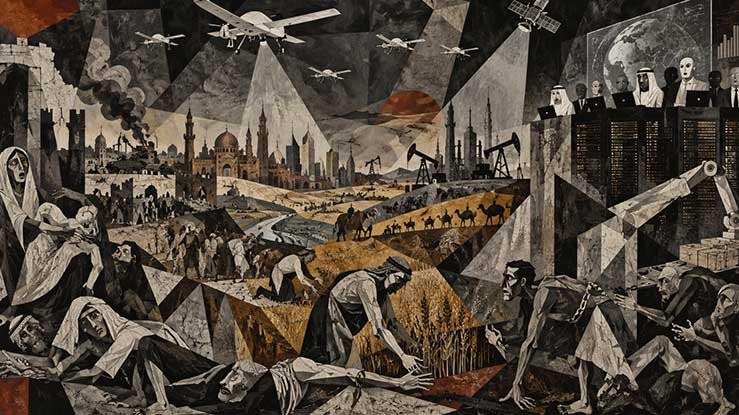
AI techno-feudalism in the Middle East: labour, surveillance, technological domination and the concentration of power.
The development of underdevelopment of productive forces was an intentional class project. This purposeful underdevelopment of technology, science and education meant an agricultural economy with vast reserve of cheap labor at the service of the comprador class and the global system. In every turn of the system productive machinery and technologies were highly guarded by the core-industrial states. The trickle-down model meant limited access to the local comprador class in order to ensure the maintenance of the system and free flawing of surplus to the core. There were two exceptions to this restriction: a) military knowledge, machinery and weaponry, and, b) ‘soft technologies’ or consumptive-technologies. The first was about order, security and punishment of the working-masses. This was and remains an essential compulsion for the local and western elites. The second was about access to technology in the consumption, trade and exchange and transportation sectors. This allowed for a smoother and ongoing operation of the international production therefore it was made relatively available in the region. This is evident especially in the third industrial revolution with telecommunication grids, internet, and mobiles. Consumptive-technologies, for the ruling forces and global order, also functioned as an ideological and cultural technique of interpellation and control. In any case, amazon, e-bay and google sell their goods online and everyone in the world must have phones and computers to be customers, including the ‘savage Orientals’.
In this sense, I think it is right to say that the ontology of technology is dialectically split. It is split both economically and geopolitically via production, private ownership and use. For the owners of the means of production, or the ruling classes with economic capital in the core-industrialised societies or periphery, technology may phenomenologically appear like the way the neutralist school envisions it. That is, as a tool, an instrument that is subject to the subjective will of social forces. It is a tool that has the capacity to be dynamic, liberating, useful and empowering for the property owners. It is an instrument that erases the necessity for this class’s bodies and minds to be engulfed in arduous soul-killing repetitive work. For this class, technology, is as Friedman celebrates it. It is a tool that allows for compression of space and time, for luxury, easy travel, communication, social interaction, pleasure, etc. In this sense, the local comprador class in the Middle East, despite the different shades of their ideological interests (nationalist, traditionalist, Islamist, etc.) is closer to the transnational capitalist class than their local peasant-proletariat masses who are stuck for them in the previous stages of Eurocentric history.
What of the class without property, the mass of workers, peasants, lumpen proletariat, the refugees and unemployed? Historical Materialist analysis demonstrates that technology is at best elusive and out of range economically, culturally and intellectually. At worst, it equates to repression, or intensification of misery and exploitation. Technologies for the masses speed up exploitation and expand control and surveillance capabilities of managers, property owners and the state. In addition, following labor-capital trends it is correct to say that through the successive industrial revolutions and introduction of new technologies, the decision-making power of the workers’ and their right and capacity to resist has been withered away. The likes of Byung-Chul Han, Slavoj Zizek, Yanis Varoufakis have recently posited that the worker’s collective power is disappearing due to changes in relations of production. Furthermore, techniques of surveillance, control and domination functioning in conjunction with Ideological and Repressive State Apparatuses allows for various new more horrifying and omnipotent means of repression and domination but also news powers of seduction. The workers, under the Fordist factory system and today what Zubboff calls ‘surveillance capitalism’, are turned into a ‘virtual cog in the machine, performing a narrow, piecemeal productive function, having little control over his or her relationship to technology, and, most important, remaining estranged from the fabrication of the total product’ (Agger 1992, 189). This is if they are lucky. There is a large subset of masses in the region which are deemed as a ‘useless class’. This ‘useless class’ desire to be exploited under the wage-slavery system. Yet they remain permanently unemployed or under-employed. The lesson is that technological systems have an owner class and they are directed against the interest of the masses. They are instruments of automation and production designed to reduce cost in production (minimise wage, fasten productivity, maker workers redundant, etc.) and increase profit for the property owners. As such technology today is a site of conflict, struggle or rebellion that is inseparable from capitalist expansion and commodification of life, nature and society. And unless there is a powerful social movement that emphasises the seizing of the means of production, revolutionary democratisation of society, the regulation, control even reconceptualization of use and innovation of technology, then the masses will continue to be at the mercy of the dictatorship of the bosses and property-owners and their savage technological regime.