
III
AI’s Polycrisis requires a Transdisciplinary Epistemology and a Radical Critique of our Unequal World
The size, form and scale of the empirical and concrete changes mentioned above are unprecedented. These quantitative and qualitative changes imposed upon society can appear to be at once fragmented, cellularised and disconnected. Yet there is also a feeling that there is a coherent systemic shift that is moving the deep structures. All at once, the tectonic plates of existing political, social and economic systems are moving and leading to a dissymmetry between the socio-ideational and material ground we stand upon. The old world is dying, so are the old ideas. As societies, economies, institutions, occupations and identities shift, a crisis in consciousness, understanding and analysis emerges.
As we speak, jobs are displaced, the masses’ attention is saturated with algorithmically curated [mis]information, demographies are profiled through facial recognition, new flashy luxury gadgets are created, entrepreneurs and investor-shareholders accumulate unprecedented gains, biomedical systems extend life expectancy, and diseases are treated at accelerated rates. AI brings both prosperity and precarity simultaneously; emancipatory potentials coexist with dispossession, optimisation advances alongside intensified surveillance and control. The benefits and burdens are unevenly distributed across classes, races, genders, regions and sectors, generating sharp discrepancies between those integrated into emerging technological circuits and those rendered redundant by them.
This dissymmetry and structural unevenness come at a material but also intellectual, psychological and existential cost. Our old methods, epistemic toolboxes, social paradigms, and intellectual traditions cease to present a coherent analysis of the situation. A widening gap emerges between lived transformation and conceptual comprehension. In the words of Hegel, when philosophy and thought ‘paints its grey in grey’:
A shape of life has grown old, and it cannot be rejuvenated, but only recognised by the grey in grey of philosophy; the owl of Minerva begins its flight only when the shadows of night are gathering (Hegel, [1821] 1991, p.23).
Hegel’s point is that consciousness and thought always lag behind actuality. Events, accidents, action, and concrete processes unfold first; only retrospectively can thought grasp their necessity and internal coherence. The subject (humanity)never possesses complete foresight at the moment of transformation. Yet Hegel’s logic does not counsel passive resignation. Rather, it insists that freedom emerges through the dialectical movement between subject and object. Thought is not external to the world but immanent within it; agency develops through engagement with contradiction. To apprehend the dialectics of subject and object in motion, in development, in totality, is to begin to comprehend the rational structure of reality as it unfolds in its many facets (Brandom, 2019). Dialectics in this sense is the logic of assessing the world, learning from the turbulations/errors that come of the subject-object contradictions via heterogenous analysis, to try and correct, fail, fail again. Only this process opens the possibility for success that is subjective (consciousness understanding the world and acting in the objective world).
In this sense, the ontological conception of AI cannot be grasped through isolated fragments, but only by mapping its multiple determinations into a dialectical whole. The different moments, phases, sets, ideas and sub-sets of the AI question and its polycrises constitute a concrete, moving totality. The problem and the answer of AI emerge from this totality, not from any single technical component. Yet this phenomenon is not static; it is in motion, containing within itself its own contradictions, negations, and transformative possibilities. As Karl Marx (1857) famously noted in the introduction to the Grundrisse, ‘The concrete is concrete because it is the concentration of many determinations, hence unity of the diverse’ (p. 101). To comprehend the nature and implications of the AI economic, sociological, psychological and political crisis, therefore, requires understanding beyond a single tradition, method, discipline and theory. It requires a metalogical analysis with variant minds, scholars, thinkers, theories, and methods examining the developing socio-economic and technological totality.
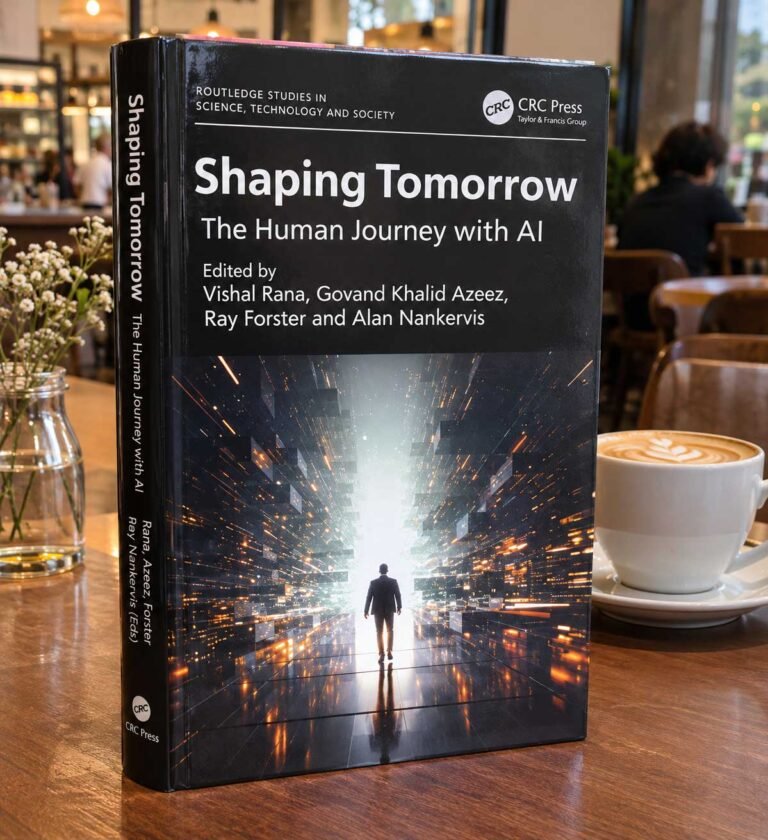
Figure 4: Shaping Tomorrow: The Human Journey with AI, an edited volume examining the technological, social and institutional transformations associated with artificial intelligence.
This is where the idea for Shaping Tomorrow: The Human Journey with AI was born. It is an attempt to operationalise precisely this dialectical demand for totality. Rather than isolating AI as a purely technical artefact, a regulatory puzzle, or a moral dilemma, the book assembles its multiple determinations into a structured, interdisciplinary whole. Philosophers and ethicists interrogate its normative foundations; computer scientists and AI developers examine architectural limits and design logics; sociologists and political economists analyse labour displacement, class restructuring, and capital concentration; legal scholars and policy practitioners explore governance, sovereignty and institutional adaptation; international relations theorists map geopolitical asymmetries and techno-nationalism; educators and social theorists assess epistemic transformation; and practitioners from industry contribute grounded case studies of implementation and unintended consequence. The editors’ own collaborative research programme exemplifies this transdisciplinary imperative, spanning political economy (Rana & Khalid, 2025), decolonial ethics (Rana, 2025), institutional governance (Rana & Azeez, 2025a), geopolitical analysis (Rana & Azeez, 2025b; Azeez & Rana, 2025), and pedagogical transformation (Rana, Verhoeven & Sharma, 2025). Each chapter functions as a determinate moment within a larger conceptual architecture, while the case studies anchor abstraction in empirical reality. In this way, the volume mirrors the very movement it describes: a unity of the diverse in which heterogeneous perspectives do not fragment analysis but are mediated into a coherent, evolving totality. The book’s global call for authors ensures epistemological plurality, while its structured synthesis ensures philosophical coherence. Through this dialectical composition, Shaping Tomorrow seeks not merely to comment on AI’s polycrisis but to comprehend it in motion.