
II
An Empirical Analysis of Dispersion of AI in the World
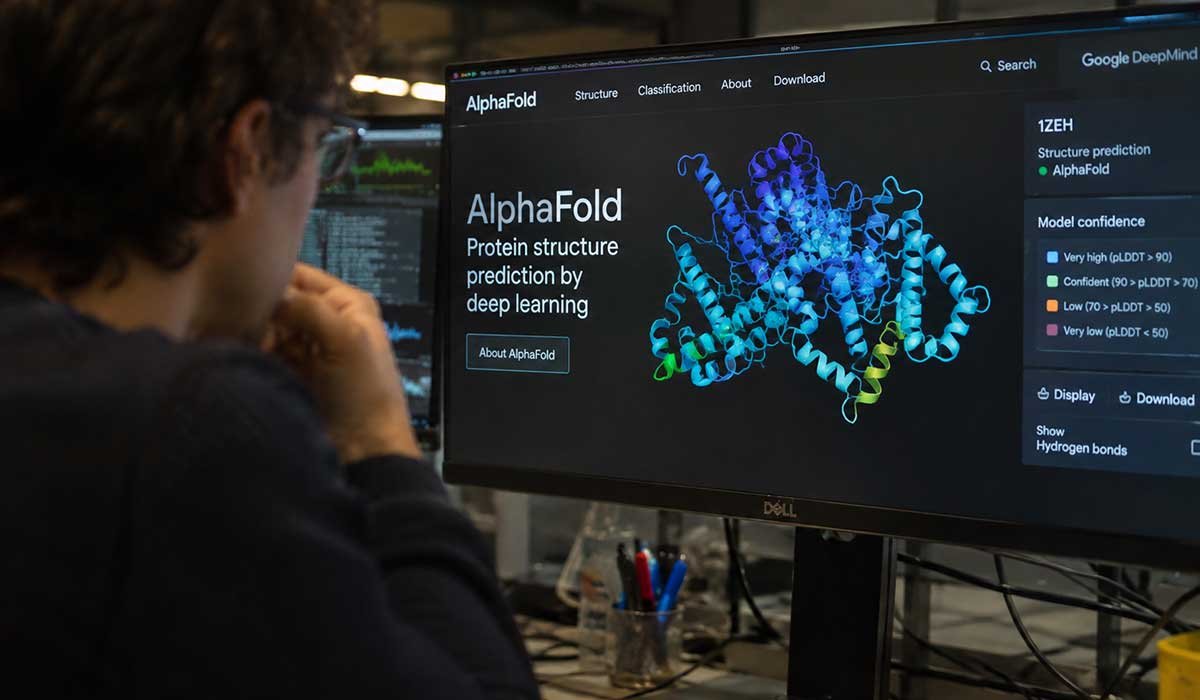
Figure 2: AlphaFold and the application of deep learning to predicting three-dimensional protein structures, transforming biological research and scientific discovery.
Artificial Intelligence is being embedded within the core structures of contemporary society. Computer systems and large language models, through assessing and learning structural patterns within vast datasets, are revolutionising societal and economic processes across various domains. From financial transactions and sustainable development modelling to smart city planning, epidemiology, gene editing, cartography, neuroscience, policing, autonomous systems, and lethal weapon systems, this paradigmatic shift has been unprecedented in scale and scope, rapid in diffusion, and transformational in impact (Robin Li, 2020, pp. 10–35). According to recent reports by FPT (2025):
The evolution of generative AI has significantly changed how humans and machines interact, especially with the development of AI agent systems. Emergen Research (2024) estimates that the global market of AI agent systems will reach 30.89 billion USD with a compound annual growth rate (CAGR) of 31.68% in the period from 2024 to 2033. The BCG analysis (n.d.) further articulates that AI agents are picking up steam across a vast array of business applications with a CAGR of 45% in the next five years… (2025, p.3)
The report goes on to show that ‘82% of businesses plan to deploy these systems into their organisations in the next three years (2024). By the end of 2025, there will be approximately 50 to 100 billion AI agents integrated into various’ spheres’ (FPT, 2025, p.3). This macro-expansion is mirrored at the organisational level. The 2025 McKinsey Global Survey reports that 88 per cent of organisations now use AI regularly in at least one business function, up from 78 per cent the previous year, and 62 per cent are at least experimenting with AI agents, with 23 per cent already scaling agentic systems within parts of their enterprise (McKinsey, 2025). A quick empirical analysis of the different disciplines, industries and fields demonstrates that AI is no longer peripheral experimentation but an increasingly hegemonic infrastructural layer of contemporary socio-economic coordination.
In software engineering, large-scale language models such as Anthropic’s Claude Code and OpenAI’s GPT-5.3-Codex have moved beyond autocomplete into planning, debugging and executing multi-step development tasks across entire repositories. Industry analysis suggests that autonomous coding agents are already responsible for a measurable share of public code, indicating that software production itself is becoming partially automated (SemiAnalysis, 2026). OpenAI has described GPT-5.3-Codex as ‘instrumental in creating itself’, assisting in debugging its own training and deployment workflows (Landymore, 2026), while systems such as Claude Code are increasingly used to iteratively refine codebases and development pipelines. These cases signal possible early forms of recursive optimisation. This technical progress is already visible in corporate practice. A recent Forbes article reported that currently, ‘AI Writes Over 25% Of Code At Google—What Does The Future Look Like For Software Engineers?’. Google CEO Sundar Pichai indicated that the future is exciting technically, but socially bleak for the engineers. He disclosed that far fewer engineers are needed. Their task is merely reviewing code written by AI (Kelly, 2024). The AI firms are telling us that programming is moving from manual construction toward agent-mediated orchestration, compressing development cycles, reducing the marginal cost of producing software, and progressively displacing routine functions traditionally performed by human software engineers.
In biology, the transformation is equally profound. DeepMind’s AlphaFold demonstrated that a deep learning system can predict the three-dimensional structure of proteins directly from their amino acid sequences (Senior et al., 2020). Rather than relying on years of laboratory experimentation, the system uses neural networks trained to model relationships between amino acid residues and to calculate the spatial constraints that determine protein folding. In independent international assessments, AlphaFold achieved levels of accuracy previously thought to require slow and resource-intensive physical experimentation conducted by tens of PhD students and researchers. What had long depended on painstaking structural biology methods can now be computationally derived at scale, reshaping how biological function is inferred from genetic sequence. As such systems integrate into genomics, drug discovery and biomedical research pipelines, the very process through which biological knowledge is generated is being reorganised (Jumper et al., 2021).
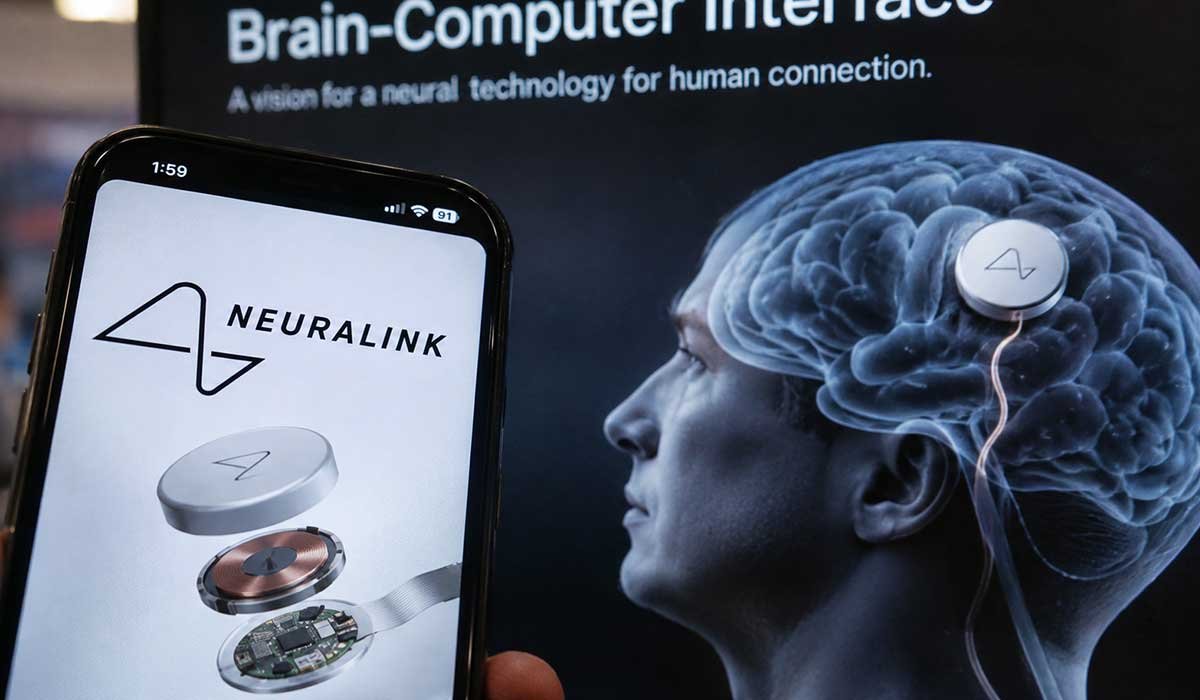
Figure 3: Neuralink and the development of brain–machine interfaces, enabling direct communication between human neural activity and computational systems.
In neuroscience, the boundary between mind and machine is becoming increasingly porous. Brain–machine interfaces now enable two-way exchange between neural tissue and computational systems, moving from laboratory research into regulated human trials. Elon Musk’s Neuralink has recently implanted its device in an Australian participant under an FDA-approved study. Recent implantation has enabled patients with paralysis to control external devices using neural signals alone (Monash Lens, 2026). When integrated with machine learning systems, these interfaces do more than restore lost motor function. They translate neural activity into analysable data streams, allowing patterns of thought and intention to be decoded, modelled and, potentially, anticipated. In this shift, neural processes are no longer confined to the biological domain; they essentially become computational inputs within algorithmic systems. As Christopher Reilly argues, the rapid commodification of brain–machine interfaces (an industry valued at approximately US$2.7 billion) raises profound questions about privacy, autonomy and the incorporation of neural life into market and corporate logics (Reilly, 2020, p. 390).
In education, the pamphlets of edtech companies and the speeches and articles of managers and executives who are firing academics and teachers tell us that the transformation is not merely pedagogical or epistemological but structural. AI adaptive learning systems, or ‘digital pocket teachers’, are presented as personalising and customising instruction at scale. These systems analyse student engagement patterns, assess performance data, and dynamically recalibrate instructional content in real time to optimise learning trajectories. Large language models such as Claude, Perplexity, and ChatGPT are increasingly marketed not simply as supplementary tools but as integrated tutors, translators, research assistants, curriculum designers, and evaluators. Platforms such as Khan Academy’s Khanmigo, Google’s AI-powered course infrastructures and certification ecosystems, and proprietary university–industry partnerships position algorithmic systems as scalable substitutes for traditional classroom instruction. Under subsidised state contracts and university administrations driven by cost-reduction imperatives and neoliberal managerial logics, these systems are reframed as efficiency-enhancing replacements rather than pedagogical complements. What is being normalised is not merely the augmentation of teaching labour, but its partial displacement through platform-mediated instructional architectures. The global education technology market, projected to reach USD 348.41 billion by 2030 (Grand View Research, 2024), signals that AI-driven infrastructures are not peripheral supplements but forces capable of materially reorganising the educational field.
In the military domain, the stakes escalate dramatically. Military experts tell us that ‘Artificial Intelligence is ushering in a new era in warfare, one in which computational agents act as scouts, advisors, and even trigger-pullers alongside human war fighters’ (Rabab’Ah and Aburass, 2025, p.36). This shift is already visible in operational practice. Autonomous drones, AI-assisted targeting systems, predictive surveillance architectures, and cyberwarfare capabilities are becoming embedded within military doctrine and procurement strategies. These systems extend decision-making speed, expand battlefield visibility, and compress the time between detection and action. Human operators increasingly supervise algorithmic systems rather than directly execute tactical functions. The institutional realignment surrounding these technologies has accelerated. Over the course of a single year, firms such as OpenAI, Anthropic, Google, and Meta shifted from publicly restricting military applications to entering partnerships with the Pentagon and defence contractors including Palantir and Anduril. This normalised the integration of frontier models into defence infrastructures. The boundary between civilian AI research and military deployment has therefore become increasingly permeable. This turn marks a techno-nationalistic reconfiguration of the state–platform relationship. Computational capacity, semiconductor supply chains, hyperscale cloud infrastructure, and model training capability are being consolidated as strategic assets. Innovation priorities are increasingly shaped by geopolitical competition. Capital allocation follows security imperatives. Research agendas align with national defence strategies. What is emerging is a 21st-century military–industrial–algorithmic complex in which geopolitical competition reorganises innovation, capital allocation, and research priorities (Srnicek, 2026).
Beyond software, biology, neuroscience, education, and defence, AI penetration extends across additional foundational sectors of contemporary life. In media and communication, AI-generated text, image, audio, and video systems are flooding civil society. It is no longer clear what is written or produced by a human and what is not. Magazines, journals and newsrooms have begun to automate reporting. James Barrat’s The Intelligent Explosion: When AI Beats Humans at Everything (2025) begins with the axiom that AI will intellectually outgrow all humans in the near future. From this, he goes on to draw a corollary outcome that ‘AI will eliminate 30 percent of all jobs done by humans, including writers’. That human writers (freelance journalists, essayists, etc.) certainly benefit from parts of their creative job being automated. ‘Soon a basic features writer, using AI, will be able to produce twice as much content and get paid twice as much…but in the long run the news organisations will get rid of most writers because people won’t care if content is written by AI or not’ (Barrat in O’Malley, 2025). The same dynamic now appears across the wider field of cultural production. Whether in advertising, film, music, design, research drafting, policy analysis, or corporate communications, algorithmic systems increasingly generate copy, visuals, scripts, campaign strategies, literature reviews, and analytical summaries at scale.
Yet this acceleration carries epistemic instability. As Choi and Mei (2025) explain, AI systems are prone to what computer scientists term ‘hallucinations’, outputs that appear coherent and authoritative but are factually inaccurate, fabricated, or contextually inappropriate. Choi and Mei (2025) write that:
Wherever AI systems are used in daily life, their hallucinations can pose risks. Some may be minor – when a chatbot gives the wrong answer to a simple question, the user may end up ill-informed. But in other cases, the stakes are much higher. From courtrooms where AI software is used to make sentencing decisions to health insurance companies that use algorithms to determine a patient’s eligibility for coverage, AI hallucinations can have life-altering consequences. They can even be life-threatening: Autonomous vehicles use AI to detect obstacles, other vehicles and pedestrians.
Such hallucinations are omnipresent and universal. In legal systems, medical diagnostics, policing, insurance determination, HR and hiring, administrative governance, financial modelling, agriculture, finance, and perhaps even worse, military targeting (Choir and Mei, 2025). The ease and speed of production of information in these fields is equally tied to the probability of error, misjudgments, miscalculations, and even catastrophe. The dispersion of AI systems is beginning to wither, weaken, and in some instances completely remove the way decisions were mediated across layers of human institutional deliberations.
Despite this expanding empirical footprint, the full trajectory of AI penetration remains profoundly uncertain. The present conjuncture unfolds moment by moment, characterised by uneven diffusion, institutional experimentation, and contradictory outcomes. The intellectual field itself is sharply divided. Sceptics such as Gary Marcus (2022), Rodney Brooks, Yann LeCun, etc., caution against exaggerated claims of imminent general intelligence, emphasising structural limitations in current architectures, data-dependence, and brittle reasoning capacities. Others—including figures associated with superintelligence discourse such as Nick Bostrom (2014), Ray Kurzweil (2005), and leading AI executives—argue that artificial general intelligence may emerge within years or even months. Between these poles lies a contested epistemic terrain. Whether AI plateaus within narrow optimisation regimes or accelerates toward qualitatively new forms of intelligence, the scale of present transformation demands rigorous epistemological and methodological assessment. The task is not prophecy but analysis: to map dispersion, identify structural tendencies, examine property regimes, and evaluate institutional realignments as they unfold. In conditions of rapid technological mutation, theoretical clarity becomes not a luxury but a necessity.